
Master Sciences technologies agriculture/alimentation/env.
Description
The objective of this international Master is to train executives able to apply and propose multicriteria assessment methods to improve the global quality of animal production systems, on the European territory. En savoir plusAccéder aux sections de la fiche
Détails
Publié le 09 February 2021
Profil du.de la diplômé.e en sortie de formation
The Master “Global Quality in European Livestock Production” training focuses on animal production systems, with a particular emphasis on methods for assessing the global quality of these systems. It is therefore centered on the different levels related to the components of global quality, from animals to raw materials, taking into account the territory and society.
The program is divided into various teaching units concerning:
Not only is this training innovative in its design with a combination of approaches in the humanities and social and biotechnical sciences, but also through its teaching methods.The teaching methods are proposed to push forward the acquisition of learners' skills:
The program is divided into various teaching units concerning:
- Livestock systems: The objective is to know the diversity of livestock farming systems and to understand the challenges surrounding livestock farming on a European and global scale. A focus will be placed on animal ethic, human relations and how to better take them into account in breeding systems.
- The different components of the global quality of production methods. The courses will make it possible to address different aspects of quality (territorial development, environment, health and safety, economy, product quality...) necessary to adapt livestock production systems.
- Global assessment methods: The objective is to provide methodological knowledge of multicriteria evaluation and to put it into practice through various case studies in France and Europe. This method will make it possible to evaluate the global quality of production systems in order to make them evolve.
- Advocacy techniques: The aim is to acquire the methods and tools to carry out advocacy action and to know how to manage controversies around livestock farming.
Not only is this training innovative in its design with a combination of approaches in the humanities and social and biotechnical sciences, but also through its teaching methods.The teaching methods are proposed to push forward the acquisition of learners' skills:
- Lectures and tutorials to acquire knowledge about the different concepts;
- Field case studies to illustrate theoretical contributions and apply the global evaluation method;
- Participation in scientific and technical symposia and organization of a seminar with professionals.
- Professional training through internships.
Compétences visées
Livestock farming is currently at the heart of many societal issues. Livestock systems must adapt in order to meet societal demands in terms of environment, health, ethical safety, product quality, territorial development, economy of animal and crop production sectors, and consumption patterns. This training meets the challenges of sustainable livestock farming, anchored in the territories, providing healthy and quality products, and crucial environmental and social services.
The objective of the Master is to train executives able to apply and propose multicriteria assessment methods to improve the global quality of animal production systems.
To achieve this purpose, students will be trained in the approach of global assessment of animal production systems in Europe.
Poursuites d'études
For the training to be as complete as possible and at the cutting edge of the various areas covered, several agronomic and veterinary institutions have joined in a consortium. The intersection of different schools of higher education and professionals from different disciplines allows us to offer a high quality training in terms of research and innovative in terms of pedagogy.
The involvement of professionals in the training is done through interventions with students, project support or internship proposal in their company. This partnership with companies is an asset that allows students’ professionalization.
Responsable(s) de la formation
- Mme Agnes PIQUET
- M. Ludovic BONHOMME
Audrey MICHAUD, Vetagro-Sup
Partenariats
Établissements
- Bordeaux Sciences Agro (Bordeaux)
- Université de Lorraine/ENSAIA (Nancy)
- INRAE
En convention avec
Vetagro-Sup
Admission
-
Niveau(x) de recrutement
Baccalauréat +3Spécialités / options du bac
- Spécialité Sciences de la vie et de la terre
- Spécialité Histoire/Géographie
Formation(s) requise(s)
The training is open to students with a Bachelor level for foreign and French students in the field of training (Biology or Geography).
A minimum level of English is required (level B2) to complete the training. -
Modalités de candidature
Recruitment is done on the basis of an application and a potential interview.
Applications are made to the Université Clermont Auvergne: Application UCAModalités de candidature spécifiques
Certains modules sont ouverts en formation continue, nous contacter via contact.mastergloqual@vetagro-sup.fr pour toute demande.
Programme
-
- Master 1 Plant/Gloqual
-
Semestre 1
-
-
-
Global change and biogeochemical cycles
-
Case studies in Livestock production
-
-
Animal husbandry basics
12 crédits
-
-
-
Livestock chains
6 crédits
-
Livestock and products: quality
3 crédits
-
Statistical bases for Biology
3 crédits
-
-
-
Optional unit
9 crédits
-
-
Research project
9 crédits
-
-
- Master 2 Plant/GloQual
-
Semestre 3
-
-
-
Livestock issues
-
Global Quality issues
-
-
Livestock geopolitics and economics
3 crédits
-
Animal ethic & philosophy
3 crédits
-
Scientific evaluation of sanitary risk
3 crédits
-
-
-
-
Multicriteria assessment method
-
Data analysis
-
-
-
-
Controversy and advocacy
3 crédits
-
Participative Process
3 crédits
-
Ressource Management
3 crédits
-
-
-
-
-
-
Bibliographic synthesis
-
Thesis
-
-
-
Synthesis document
-
Thesis
-
-
-
-
-
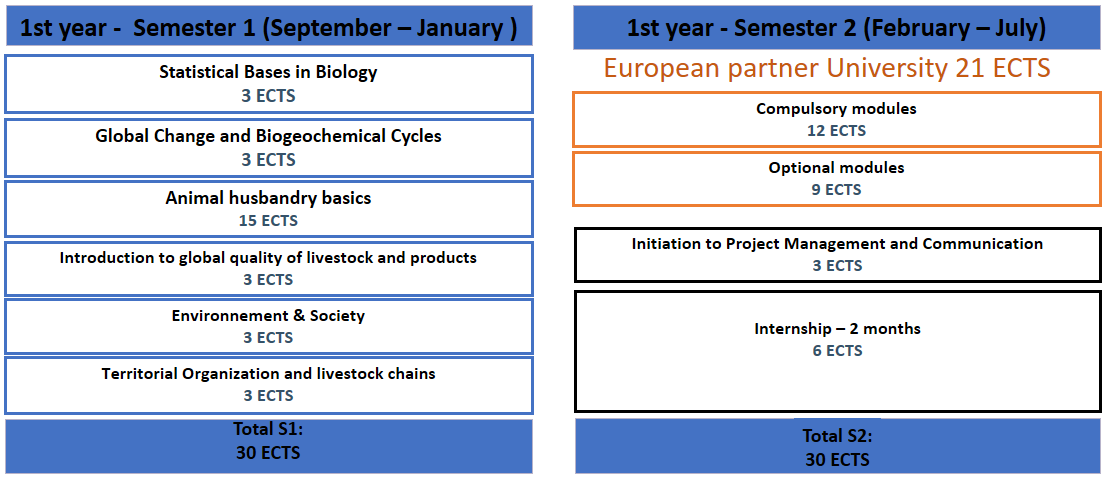
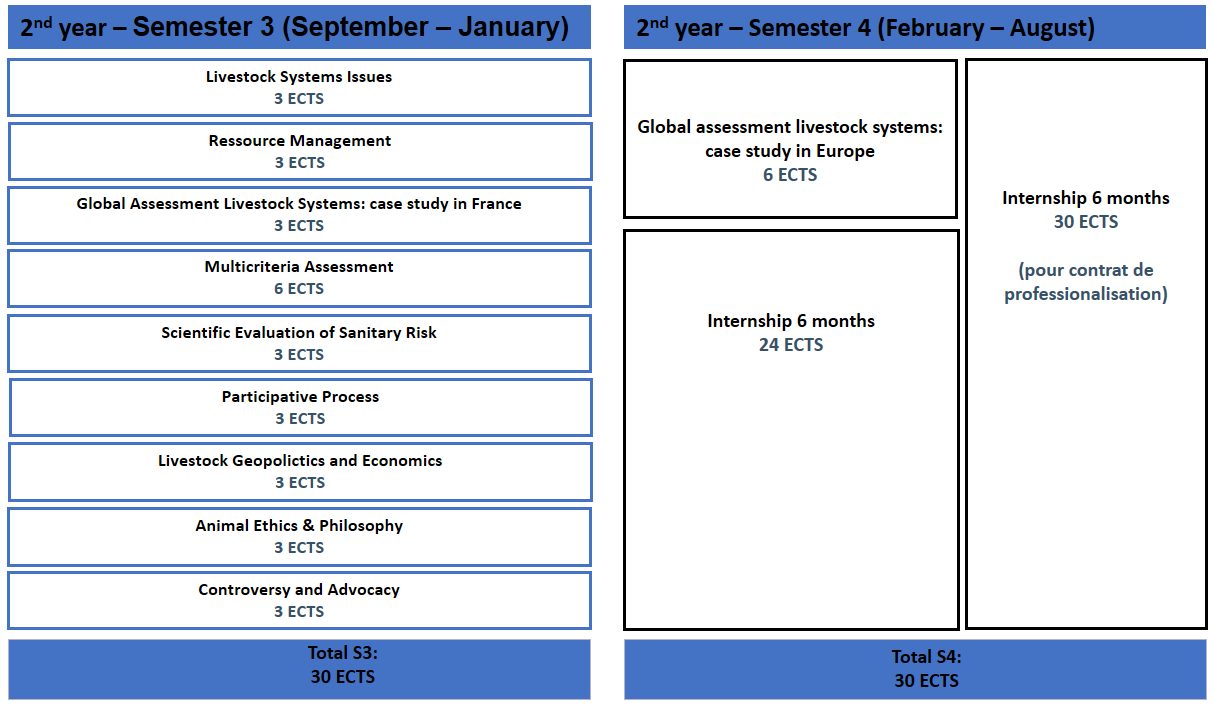
In France or abroad, in companies or research laboratories, there are two internships:
- a 2-month internship at the end of the Master 1
- a 6-month internship at the end of the Master 2 (Master thesis)
The search for an internship placement is considered a professionalizing process because it allows the student to position his or her professional project in a real socio-economic context.
The active search for internships and the design of communication tools (CV, cover letter) contribute to the preparation of the student for his or her profesionnal insertion. This also allows the student to target internship subjects that are closer to his or her concerns, in agreement with the master's pedagogical team. -
After a period in Clermont-Ferrand, 2nd semester of the Master 1 takes place in one of the European partner Universities.